


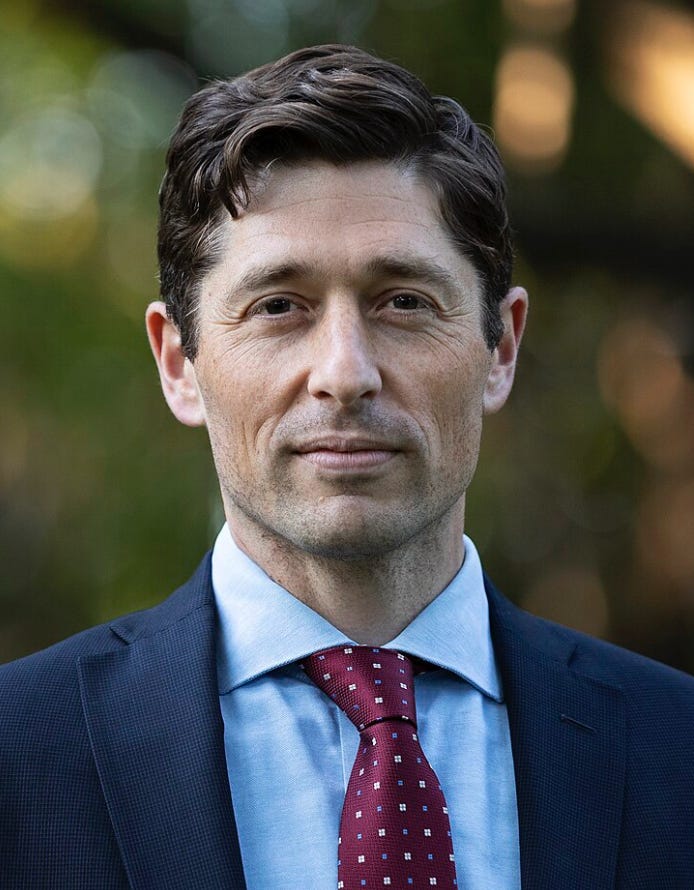
Over the holidays, Blue North Beacon had the privilege and pleasure to interview with Minneapolis Mayor Jacob Frey. In our conversation, the Mayor reflects on his takeaways from the election, discusses resetting relations with the city council, and offers some political advice for Democrats heading into 2026 and some personal advice for this expecting father! Below, the transcript of the interview has been printed in its entirety.
Jordan Hagert (BNB):
Looking back at November’s results, what’s your single biggest takeaway from the voters of Minneapolis – both in your own reelection and in the way they shaped the new City Council?
Mayor Frey:
People want elected officials to be straight up with them. They’re tired of a whole lot of talk where it’s not really saying anything. People appreciate honesty even when it’s not exactly what they want to hear. And they want you to love your city more than you love your ideology. That was very clear.
We built out a broad coalition across the city of Minneapolis that included every demographic race, ethnicity, religion, and background. And we saw that coalition lead to the highest vote total. We’ve ever seen in the city’s history, with the exception of one election back in like the 50s or so.
The results speak for themselves. We’re obviously really excited about it and we’re running with a head full of steam here going forward.
Hagert:
A lot of the national coverage framed your race against Senator Fatih as centrist versus democratic socialists in a proxy fight for the soul of the democratic party. Do you accept that framing and what do you think it misses about the democratic party and or how Minneapolis really works?
Mayor Frey:
First, I suppose politics are always relative, but if you put me in any other city in the entire country, I would definitely be a progressive. Look, let’s touch on every single issue out there - I have the progressive position - with the exception of things that don’t work like rent control.
Rent control doesn’t work in any city in the entire country. I don’t care whether you call it a leftist position or a conservative position, it doesn’t work.
Defunding the police doesn’t work. It doesn’t make sense, we need safety in the city, we need law enforcement, and so I think I often times get labeled with not being progressive because I’m not for policies that the rest of the democratic party, for the most part, tries to run away from. I don’t take those positions in the first place.
So, I mean, obviously, the national political spotlight will try to brand the race in a simplistic fashion, but what I think people are looking for is common sense. I think they’re looking for an honest take.
Hagert:
That’s a good segue to my next question, if you had 60 seconds with national democratic leaders and strategists, what would you tell them that Minneapolis teaches about messaging to a coalition that includes both Frey and Fateh voters under that same blue umbrella?
Mayor Frey:
Tell people the truth. Don’t talk to them in a language that they don’t understand and give them arguments that don’t make sense. Voters are smarter than that, give the voters some credit. I think they can spot a fake from a mile away and they can also spot authenticity.
I think what you saw over this last cycle is that authentic candidates ultimately won these races. And for the most part, the best candidates won the race.
So if the Democratic Party is really going to be a big and broad tent full of ideas from both leftist, progressive, and moderates - we’ve got to actually walk that walk, and I think at times we haven’t.
At times, we have excluded people because they aren’t willing to just sign on, hook line, and sinker without talking things through. I’ve seen this gravitational pull right now to the extremes. And the opposite of Donald Trump extremism is not the opposite extreme. The opposite of Donald Trump extremism is good, thoughtful governance where you’ll love your city more than your ideology, and you’ll listen to facts and experts. And that’s the direction that we are taking, and clearly it’s the direction that won the day (in the November elections).”
Hagert:
I love that, looking ahead now, you have talked a lot about wanting a reset with this new City Council - what specifically does that reset look like in the first six to twelve months? And where do you see the most immediate overlap between your agenda and the Council’s - the easy wins for collaboration if you will?
Mayor Frey:
Yeah, people expect a reset. People expect their mayor and council to work together. I think the lowest bar of expectation they can have is that we will work together and not against each other for the best of our city.
And so a reset is necessary here where we’re treating each other like human beings, where we’re not attacking each other personally and name calling. And I mean, it’s just generally the golden rule here in politics, the rule that applies in the rest of society - treat people the way that you want to be treated yourself.
To do that, there needs to be a level of mutuality. When I called for a reset, he immediately saw the council president dismiss those calls for a reset in the press
But look, I’m going to play my part. I am going to assume good intentions. And I’m going into this term again, with a goal of finding common ground, not finding the fault lines. My only ask is that other people go into that new term with the same intention. And I’m glad that the four new Council Members signed a joint statement agreeing with that spirit of unity and collaboration.
I think that there’s like 90% alignment on the basis. I mean, we’re all for building more affordable housing. We’re all for reducing our per capita carbon.
Hagert:
On a related noted, can you walk us through the budget deal that was just negotiated? Do you think that agreement is a good sign for the next term?
Mayor Frey:
I think it’s a good sign for the next term in the sense that we had a deal, uh, specifically council Vice President Chughtai stuck to that deal. And look, I’m not thrilled with the budget. Um, I, I think that there are parts of it that are fiscally irresponsible and you know, it spends more than $10 million of additional money at a time when we don’t have a lot of money to spend. Uh, but we got to a deal that worked for both sides. We got to a deal that I would venture to guess neither side was totally thrilled with.
We agreed (on a deal) and Council Vice President Chughtai, to her great credit, held her word, and that’s integrity in my mind; even when you disagree, you hold your word and you do the things you say you’re going to do. Certainly there were others that tried to stop the deal. But the fact that, you know, ultimately I think it was a unanimous or near unanimous vote with one council member leaving before the vote. I think that says that - hey, we can work together.
I think one of the things that people in the city asked for during this last election was to have people work together and try to find common ground. Council Vice president Chughtai drove a difficult negotiation. It got us to a conclusion again that I’m not thrilled with but was good enough that I could sign it and certainly good enough that she could support it. That’s how government should work.
Hagert:
So we talked a lot about politics, but want to get to some specifics on some policy too, particularly an issue that’s been a top priority of yours since day one and that you’ve had some success on. What do you hope to get done to support the continued expansion of affordable housing in the final term?
Mayor Frey:
This is perhaps the item that I’m most proud of in terms of our policy accomplishments. We’re producing eight and a half times the amount of deeply affordable homes before I took office. We have managed to keep down rent more than virtually any city in the whole country, not through rent control, but through increasing the supply of homes.
And we have pushed back on very intentional segregationist efforts of the past and present where we’re allowing for a diversity of housing options and therefore a diversity of people in every neighborhood. We’ve started programs like home stable schools that have successfully housed around 6,000 kids in our Minneapolis public school system and beyond. This is work that we need to continue.
And wherever we can, I believe in doubling down on this work because I believe that a home is a foundation from which someone can rise. You give someone a home and you give someone the stability of life, you know, a roof and walls and a safe place. Then they can take a breather that they can kind of recalibrate after a tough day and they can then start to believe in themselves and their chances in the world. They can fight off an addiction. They can get a job. They can do all the things in effect once they have a home. And so that’s a kind of a core foundational belief for me. It’s like, we’re not going to give people the world but giving people a home, that’s something we can do.
Hagert:
The City of Minneapolis works closely with the state and federal governments. So the outcome of the upcoming governor’s race and the Senate and House races are extremely important to the city. What advice do you have for Democrats generally to be successful in the 2026 midterms? And then specifically, what advice do you have for Governor Walz as he sets out to secure a third term like you were able to do this November?
Mayor Frey:
Yeah, I don’t think that I’m well positioned to give Governor Walz advice on how best to secure a third term. What I can say and will say is that he’s the right one for the job.
He has, and I have been through some of the most difficult situations that this world could offer. It’s not as if we said the word pandemic probably a single time when we were first running for office. That wasn’t a thing. This was a huge new issue we had to deal with. It was an issue that had severe repercussions that have reverberated until today and beyond. And I have a lot of both sympathy and respect, deep respect, for leaders who have navigated those challenging times.
I would say this about myself. I imagine the governor would say it about himself as well, is that I ain’t the same mayor as I was when I was first. You’re weathered in a way, in a good way, in a way where you’ve seen some shit but when you approach it in the future you’ve seen it before.
And so, you know, things that would have taken me the better part of the day to deal with now take me five minutes - why, because I’ve already done it. And so I think the governor’s well-positioned, obviously, any statewide race is going to be a tough fight but he’s the right one for the job. He has my full and 100 percent support.
Hagert
For the people who voted against you, or who feel politically homeless between the centrist and progressive camps, if you will, what’s your pitch that Minneapolis can be a place where internal democratic fights produce better policy, not just louder arguments?
Mayor Frey:
Well, first off, if you’re somewhere between a centrist and a leftist, then that’s probably exactly where I’m at. I would check out where I’m at, whether it’s raising the minimum wage, building record amounts of affordable housing, being as pro-choice as you can get, to protections for the trans community.
As Mayor, you make a lot of decisions. People will be frustrated at me for exactly the opposite reasons. I mean oftentimes for years their critiques that I would get were number one, not enough cops and number two, too many cops.
Well, in other words, in a city, we deal with all the issues that other levels of government don’t want to touch with a 20-foot pole, and one’s an issue that’s either, at times, politically problematic or sticky. That’s when the city steps in and takes over.
And so, to those that don’t like me and vote against me, I respect that. I’m still your mayor, and me being your mayor means I’m going to hear you out. It means that I’m going to take your feedback very seriously, and it means that we’re going to have a respectful, broad conversation about the future of our city. And so, I’m not just a mayor for the people to vote for me. I appreciate the over 50% that did. But for those that didn’t, God bless you for loving the city. God bless you for voting and expressing yourself. I hear you.
Hagert:
I love that answer. Okay, softball for you - what do you love the most about being the Mayor?
Mayor Frey:
Yeah, I mean, look, I/ll give you the truth which may sound like a cliche answer but they really go hand in hand. It feels really really good to be able to like attack a really hard issue that nobody else wants to touch. You go hand and hand with the city, you work through the issue, and then you make their lives better and the city a better place to live.
When you accomplish that, I mean, there’s nothing that feels better than that. When you get a kid at home, there’s nothing that feels better than that. When you’re able to help a space that was crime ridden that feels good. So when I get to be a part of that, it’s really fulfilling.
It feels so great and I love the city you know and I want to be part of its history and its story. And I want to obviously leave a legacy of the work we’ve done.
It’s also really hard in that you are dealing with issues that often times really piss people off.
You know if you go to the state or the federal government, the issues that you’re dealing with they’re inspirational and they’re hard they’re long-term where you make a decision and maybe a couple years down the road you see the impact. Here in the city, it’s the it’s the stuff that pisses people off, it’s the pothole in your streets, it’s the gun shots going off a block away - I mean that more than pisses you off, that’s dangerous. It’s all the stuff that impacts your day to day to real life and when you make a decision, when I make a decision, a lot of time it is pretty apparent whether it was a good or a bad decision within a matter of days sometimes hours.
And when you have that level of contact with the people that you serve, you also get very direct feedback, which I both appreciate, but it can also be very intense and wearing. I mean, when I walk out on the sidewalk in the morning on a Sunday with my daughter, the second I hit the sidewalk, I’m the mayor. You know, when I go to the grocery store across the street, I’m not just getting some bananas for the pancakes, I’m the mayor. But you know, I’m an extrovert so I love people, and I do love the interaction. I think you’ve got to be somewhat of an extrovert to be able to do this job really otherwise it would be hard.
Hagert:
Lastly, a personal question, I asked what advice you had for Governor Walz and securing a third term but what do you got for advice for this expecting father going from one to two kids?
Mayor Frey:
Oh man! Congratulations, we’re so happy for you, thats awesome! Tell Lauren congrats! Oh man, get ready, it’s way harder! Learn to put in a ponytail if you haven’t done that yet, and if you can figure out braids, learn that too!
Hagert:
Well thanks a ton, we really appreciate you taking the time to chat with us today. Happy holidays to you and the family!
Mayor Frey:
Of course, and happy holidays to you and yours!